
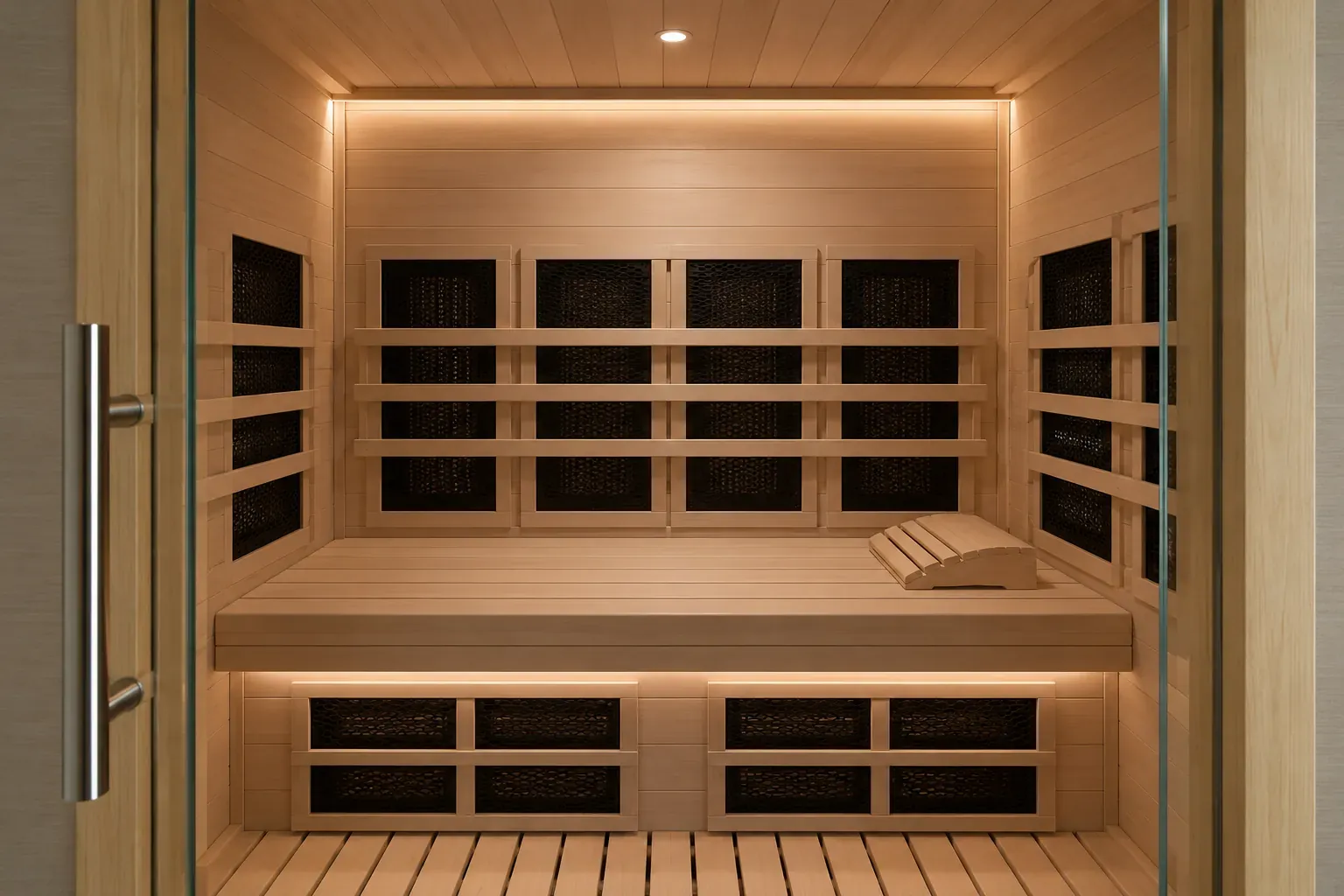
Infrared sauna vs traditional sauna
These are different technologies solving the same problem in opposite ways. A traditional sauna heats the air around you to 80 to 100°C. An infrared cabin heats you directly with radiant panels while the air sits at 45 to 60°C.
For a lot of Dubai apartments the choice is made by the distribution board rather than by preference, which is worth knowing before you develop a strong opinion.
How each one heats you
A traditional heater warms air and a mass of stones. The air carries heat to your skin, sweating starts within a few minutes, and pouring water on the stones produces a short humidity burst that raises perceived temperature sharply.
Infrared panels emit radiant heat that your body absorbs directly, much as sunlight warms you on a cool day. The air stays relatively cool. Sweating starts more slowly but does happen, and many people find it more comfortable precisely because they are not breathing 90°C air.
The electrical difference, which usually decides it
A 6kW traditional heater needs a dedicated 32A circuit. From 9kW you generally need three phase, which villas commonly have and apartments rarely do.
Most infrared cabins run at 1.5 to 2.5kW from a standard 13A socket. No new circuit, no board upgrade, no electrical certification headache, and building management is far more likely to issue an NOC.
In practice this is why we install so many infrared cabins in Dubai and Ajman apartments. It is not that clients prefer them; it is that they are the version that can actually be built.
Cost
Infrared cabins run AED 15,000 to 38,000 supplied and installed. Traditional cabins run AED 18,000 to 55,000 modular, or AED 32,000 to 95,000 custom.
Running cost favours infrared too — a 2kW cabin reaching usable output in fifteen minutes uses far less than a 6kW heater running for forty. Over a decade of daily use that gap is not trivial.
The experience, honestly
People who love traditional saunas usually find infrared too mild. There is no löyly, no steam burst, no sharp heat on the skin, and if that ritual is what you are buying then infrared will disappoint you.
People who find traditional saunas oppressive often prefer infrared for exactly the same reasons. It is easier to sit in for thirty minutes, easier on the airways, and easier to read in, since the air is not hot enough to make that unpleasant.
Our honest summary: if you have used and enjoyed a real sauna, build a traditional one if your board allows. If you have not, or if dry 90°C air has always felt like too much, infrared is a legitimate choice rather than a compromise.
Maintenance
Infrared is close to maintenance-free. No stones to replace, no water, no humidity in the cabin. Panels last a long time and there is very little to service.
Traditional cabins need an annual service and stone replacement every one to two years. Neither is expensive, but it is a difference worth knowing.
Health claims, briefly
The cardiovascular research everyone cites was done on traditional Finnish saunas at Finnish temperatures. Applying those findings to a 50°C infrared cabin is not supported, and companies do it constantly.
That does not make infrared useless — reported effects on relaxation and muscle comfort are real enough. It does mean you should discount any infrared marketing that leans on the Finnish mortality studies.
Deciding between them for your property
The distribution board usually decides it. Pre-built and infrared sauna cabins are the route where capacity is limited, and custom sauna room installation is the traditional version where a dedicated circuit is available.
Sauna heaters and the sizing rule are covered separately if you want to check the numbers yourself. We do sauna and steam room installation in Dubai and will open the board at survey rather than guessing.