
Sauna wood and heater choices, explained
Two specification decisions carry a sauna: the timber and the heater. Both are routinely got wrong, and both are expensive to change once the cabin is clad.
This is what we specify and why, including the choices we actively avoid.
Nordic spruce
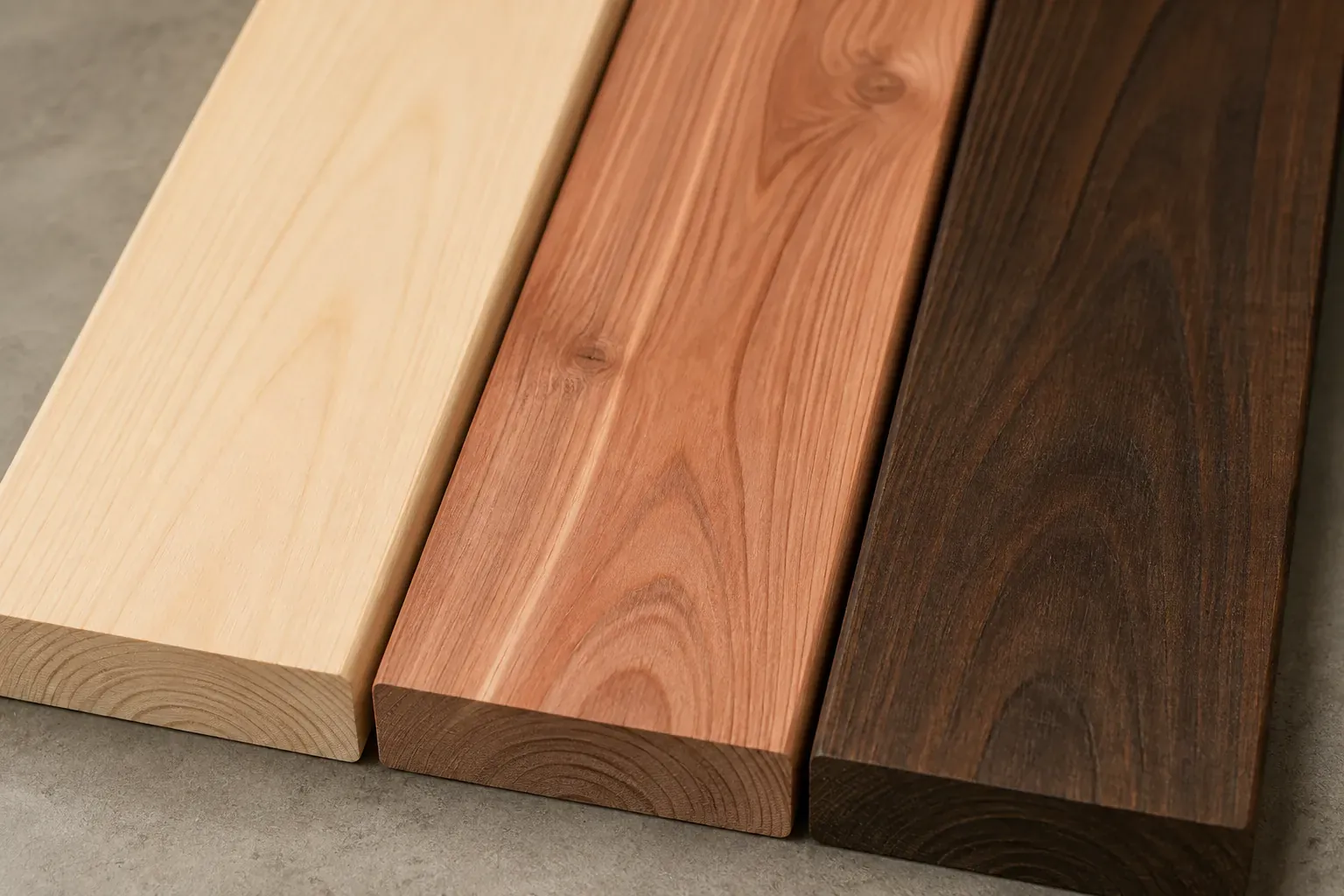
The default in Finland and a sound choice here. Pale, light, dimensionally stable, and the cheapest of the good options.
Good for walls and ceilings in internal cabins. Not suitable for outdoor use in this climate — UV degrades it within a few years.
Hemlock
Our most common internal specification. Pale, very consistent in colour, close to odourless, and stable at sauna temperatures. Slightly more expensive than spruce and worth it for the uniformity.
If you want a calm, even-toned cabin, hemlock is the one.
Western red cedar
The premium option. Warm reddish tone, naturally resistant to moisture and decay, and it has a distinct aroma that people either love or find intrusive. Around double the cost of hemlock.
Works internally and externally. If aroma matters to you, this is the timber; if you are sensitive to it, it is not.
Thermowood
Thermally modified timber, cooked at high temperature to drive out sugars and moisture. It does not feed mould, moves less with humidity, and holds up under UV far better than untreated species. Dark brown when new, silvering gradually.
Effectively mandatory for outdoor cabins in the UAE, and particularly on the east coast where humidity is higher. Roughly 40% more than spruce.
Bench timber is a separate decision
Whatever the walls are, benches go in knot-free abachi or aspen. This is not aesthetic — knots conduct heat far faster than surrounding timber and reach skin-burning temperature in a cabin at 90°C.
Abachi is very light, low density, barely warms to the touch. Aspen is similar and slightly cheaper. Never cedar benches in a hot cabin, and never anything with visible knots.
Acclimatisation, which matters more here than in Europe
Sauna timber is milled and seasoned for Northern European conditions. Bring it straight from a shipping container into a UAE villa and fix it down the same week, and it will lose moisture for months afterwards — shrinking, cupping and splitting after the cabin is finished and the invoice is paid.
We let timber sit in the space for one to two weeks before installation so it reaches equilibrium with the room it will actually live in. It is an unglamorous item on a programme and it is the difference between cladding that stays tight and cladding that opens at the joints in its first summer.
Fixing method matters for the same reason. Bench slats go on slotted fixings from underneath, with an 8mm gap between them, so every board can move independently as humidity swings between an air-conditioned house and a 90°C cabin. Boards pinned hard at both ends have nowhere to go and split along the grain instead.
What never goes inside a cabin
Treated or pressure-impregnated timber — it releases the treatment chemicals when hot.
Resinous pine with visible knots, which weep sap at temperature.
Any varnish, lacquer or sealer on internal surfaces. Coatings blister at 90°C and trap moisture in the timber beneath. Sauna interiors are left bare, always.
Heater sizing
Roughly 1kW per cubic metre of cabin, plus about 1kW for each square metre of glass. A 1.8 by 2.0 by 2.1 metre cabin is 7.6 cubic metres, so an 8kW unit; add a glass front and you are at 9kW.
A 6kW heater needs a dedicated 32A circuit. From 9kW you generally need three phase. This is the constraint that most often decides cabin size in apartments.
Brands and stones
Harvia and Tylö are what we fit most, chosen as much for parts availability in the UAE as for the units themselves. Sawo is good value. EOS and Helo are excellent but parts take longer to arrive here, which matters in year six when something fails.
Stones in peridotite or olivine, stacked loosely so air moves through the element. Replace every one to two years domestically, annually in commercial use. Fractured stones pack down, restrict airflow and shorten element life — it is a cheap job that prevents an expensive one.
Specifying it properly
Sauna heater supply and sizing covers the calculation and the brands we fit, including replacements for cabins built by other companies. Custom sauna room installation covers the timber specification as part of the build.
Sauna maintenance and stone replacement is the ongoing item most often skipped, and it is what shortens heater life more than anything else. We do sauna and steam room installation in Dubai and hold parts for the five heater brands we fit.