
The difference between a sauna and a steam room, explained
People use the words interchangeably, and in a gym the two rooms often sit side by side looking similar. They are not similar. They operate at different temperatures, at opposite ends of the humidity range, and they are built in fundamentally different ways.
If you are trying to decide which to install, the construction difference matters more than the experience difference, because it is what sets the price and the maintenance burden.
Temperature and humidity are inverted
A sauna runs at 80 to 100°C with humidity between 5 and 15 percent. A steam room runs at 43 to 46°C with humidity at 100 percent.
That inversion explains why a 90°C sauna is tolerable and a 46°C steam room feels hot. In dry air, sweat evaporates and carries heat away from your skin. In saturated air it cannot evaporate at all, so the heat stays with you. The thermometer reading is close to meaningless between the two.
The construction is where they really diverge
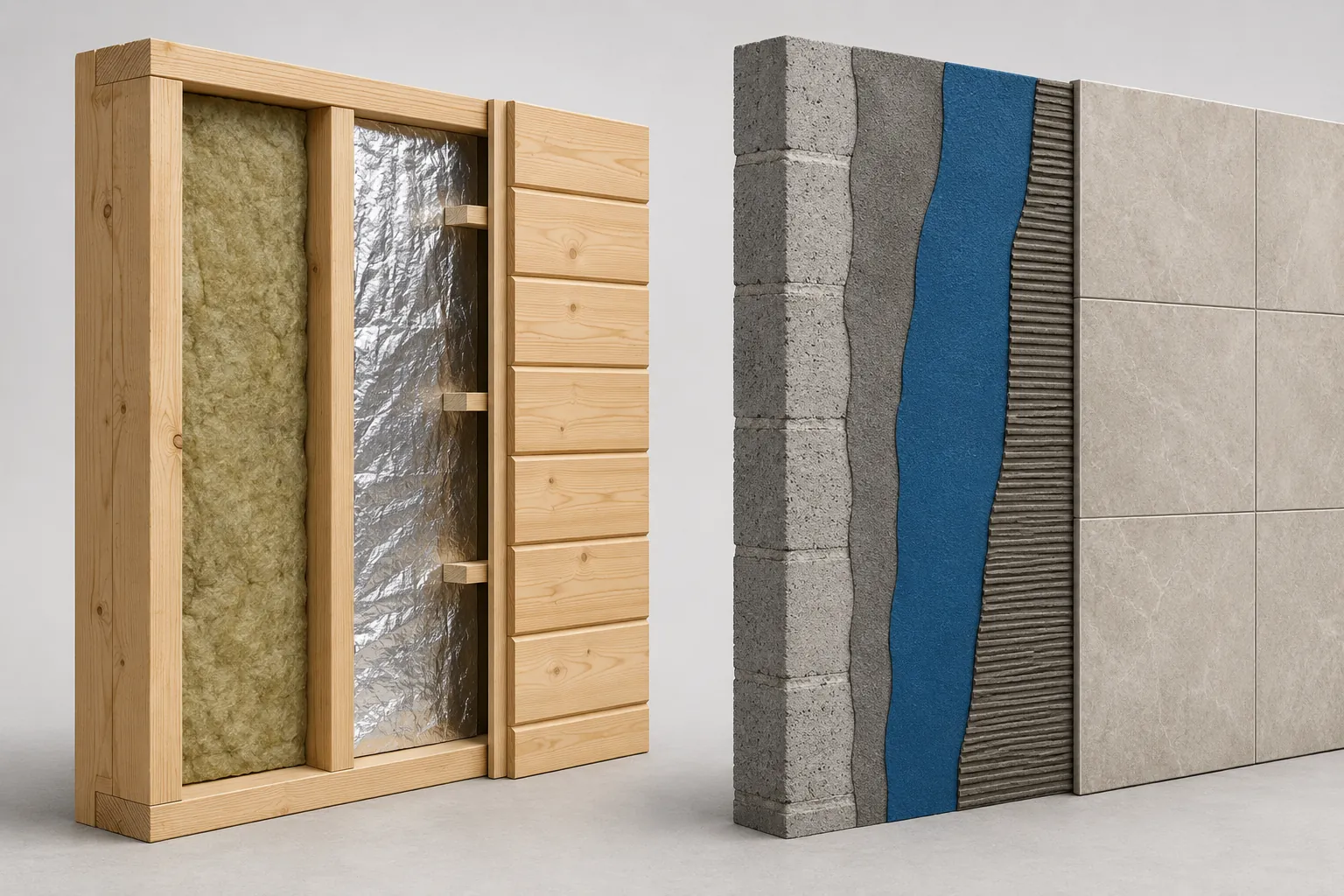
A sauna is a box built inside a room: timber frame, mineral wool, a continuous foil vapour barrier taped at every joint, a ventilated cavity, then cladding. The barrier's job is to stop the small amount of moisture in the cabin reaching the insulation. Nothing about the construction is waterproof in the plumbing sense, because it does not need to be.
A steam room is a tanked wet box: substrate, liquid-applied waterproof membrane taken up every wall and reinforced at corners and penetrations, then adhesive and tile. It has a fall to a drain, a sloped ceiling so condensate runs to a wall instead of dripping, and a sealed door. It is genuinely waterproof, and it has to be, because the air inside is holding all the water it possibly can.
Heat sources work differently
A sauna heater warms air and a mass of stones. Pouring water on the stones produces löyly — a short humidity burst that raises perceived temperature sharply before fading. The room returns to dry within a couple of minutes.
A steam generator boils water in a tank and pipes steam into the room through a low outlet. It runs continuously to hold saturation, which is why generator sizing against room volume and tile type matters so much, and why the generator scales up in UAE water.
Different failure modes
Saunas fail slowly and invisibly: a punctured vapour barrier lets moisture into insulation, the insulation stops working, the timber moves, and by the time anyone notices there is a smell rather than a leak.
Steam rooms fail visibly and expensively: water finds a route through a tanking detail and appears as damp on the far side of the wall, usually in the bedroom or corridor behind. The equipment is rarely the culprit.
Which word applies to what
A sauna is dry heat, always. A steam room, steam bath and Turkish bath all describe wet heat, though a Turkish hammam adds heated marble and is a different construction again. A steam shower is a small sealed shower enclosure doing the same job as a steam room in less space. An infrared cabin is neither — it heats your body directly with radiant panels at 45 to 60°C rather than heating the air.
What this means if you are building one
The construction difference is the practical one. If you want to see it in detail, how a sauna cabin is built covers the frame, barrier and cladding sequence, and tanked steam room construction covers the membrane, falls and ceiling form.
As sauna and steam room contractors in Dubai we build both, plus Turkish hammam construction where the brief calls for heated marble rather than either of these.