
Steam room waterproofing and tanking, done properly
When we are called to a failed steam room, it is almost never the equipment. It is water that found a route through the tanking into the structure behind, and it has usually been travelling for months before anyone noticed damp on a bedroom wall.
The failures are not random. They happen at four details, every time, and all four are cheap to get right and expensive to correct.
What tanking actually is
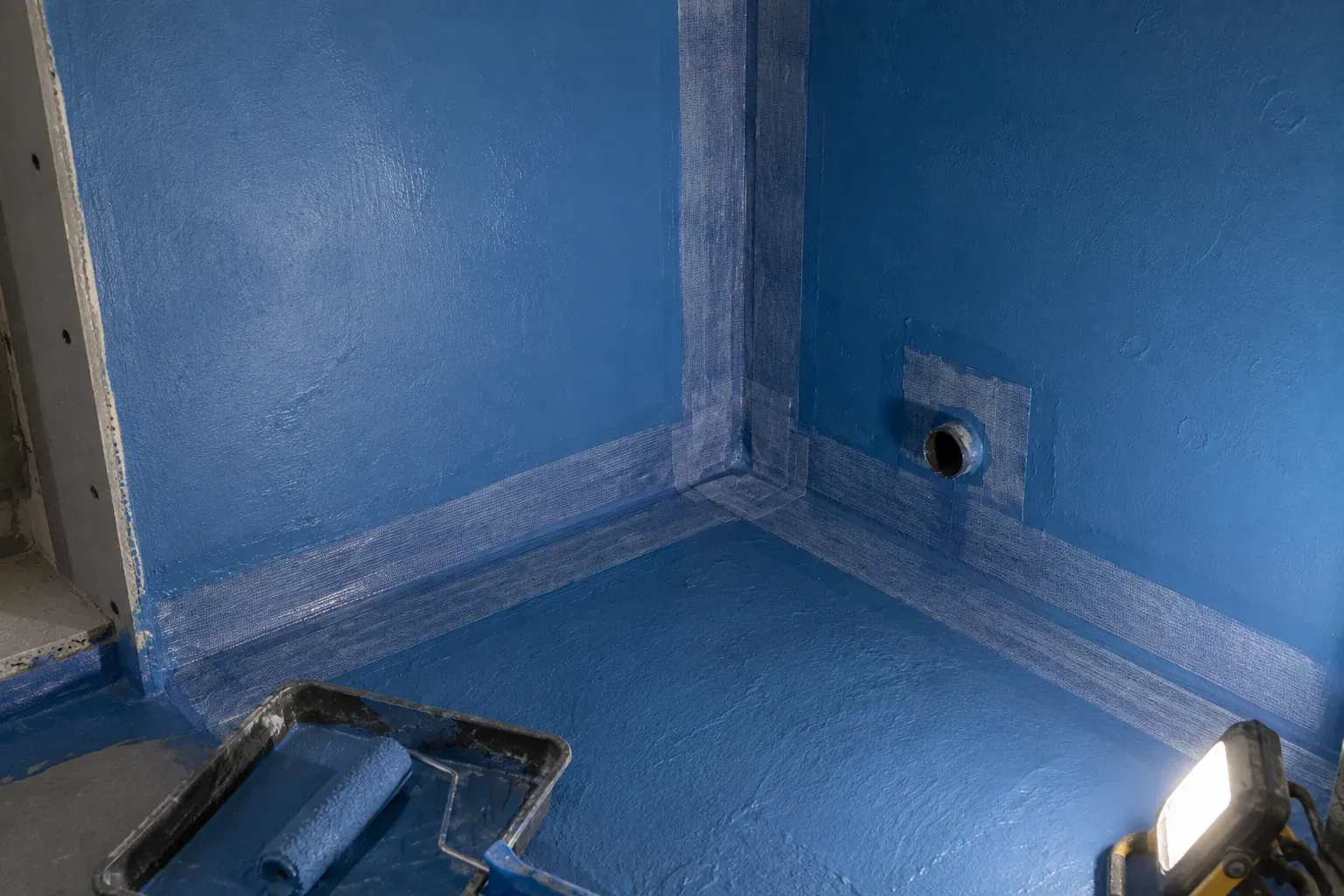
A liquid-applied waterproof membrane rolled or brushed onto the substrate, reinforced with tape at every internal corner, junction and penetration, taken up every wall to full height in a steam room and lapped across the floor.
It is not the tile and it is not the grout. Tile and grout are finishes, and both are permeable at the timescales a steam room operates over. The membrane is the waterproof layer and it sits underneath, invisible for the life of the room.
Full height matters. A normal shower is tanked to shoulder height because water lands on you and runs down. In a steam room the saturated air reaches the ceiling, so the ceiling gets tanked too.
Failure point 1: internal corners
A membrane rolled onto a flat wall is fine. A membrane taken around a 90 degree internal corner stretches thin at the angle and cracks with the smallest movement.
That is what the reinforcing tape is for — bedded into wet membrane, in every internal corner, then overcoated. Skipping the tape and simply applying extra membrane in the corner is the commonest shortcut and the commonest failure.
Failure point 2: penetrations
Every steam head, light fitting, sensor, control cable and pipe passing through the membrane is a hole in your waterproofing. Each one needs a collar or tape detail bonded to both the membrane and the component.
Lights are the worst offenders because they are usually fitted last, by someone who was not there when the membrane went on, and are simply pushed through a hole cut in a finished surface.
Failure point 3: the threshold
Where the steam room floor meets the bathroom floor, the membrane has to be continuous across the threshold and lapped up on both sides. A door track fixed through the membrane after it has cured is a direct route into the floor build-up.
This is where water most often exits into the room next door, because it is the lowest point and gravity is patient.
Failure point 4: substrate movement
A membrane on a substrate that moves will crack regardless of how well it was applied. Plasterboard is not an appropriate substrate for a steam room. Cement backer board or a rendered masonry substrate is.
We have opened steam rooms built on standard plasterboard with a painted acrylic coating over it. They fail, without exception, and usually within two years.
The product substitution to watch for
A proper liquid membrane system costs a few thousand dirhams for a domestic room. A painted-on acrylic 'tanking' product costs a fraction of that and looks similar once tiled.
If a quote is significantly cheaper than others and the specification does not name a membrane system, this is where the saving is. Ask for the product name in writing before you compare prices at all.
Diagnosing an existing leak
Damp on the far side of a steam room wall is a tanking failure and resealing the visible grout will not fix it. It hides it for six months.
Proper diagnosis means tracing which of the four details above has gone, which usually means opening a section. We charge for the diagnostic visit and give a written finding with photographs before pricing any repair, because the scope is genuinely unknown until the wall is open.
Repairs range from re-detailing one penetration to stripping and re-tanking the room. The honest answer is that a room built on plasterboard with a painted coating is usually a strip-out.
Who carries the risk
On turnkey work the waterproofing is our workmanship and our warranty. Steam room installation sets out the tanking sequence in detail, and steam room contractors explains why split scope between tiler and plumber is where leaks come from.
Steam room repair covers leak diagnosis, which we trace properly rather than resealing grout. We are sauna and steam room contractors in Dubai.