
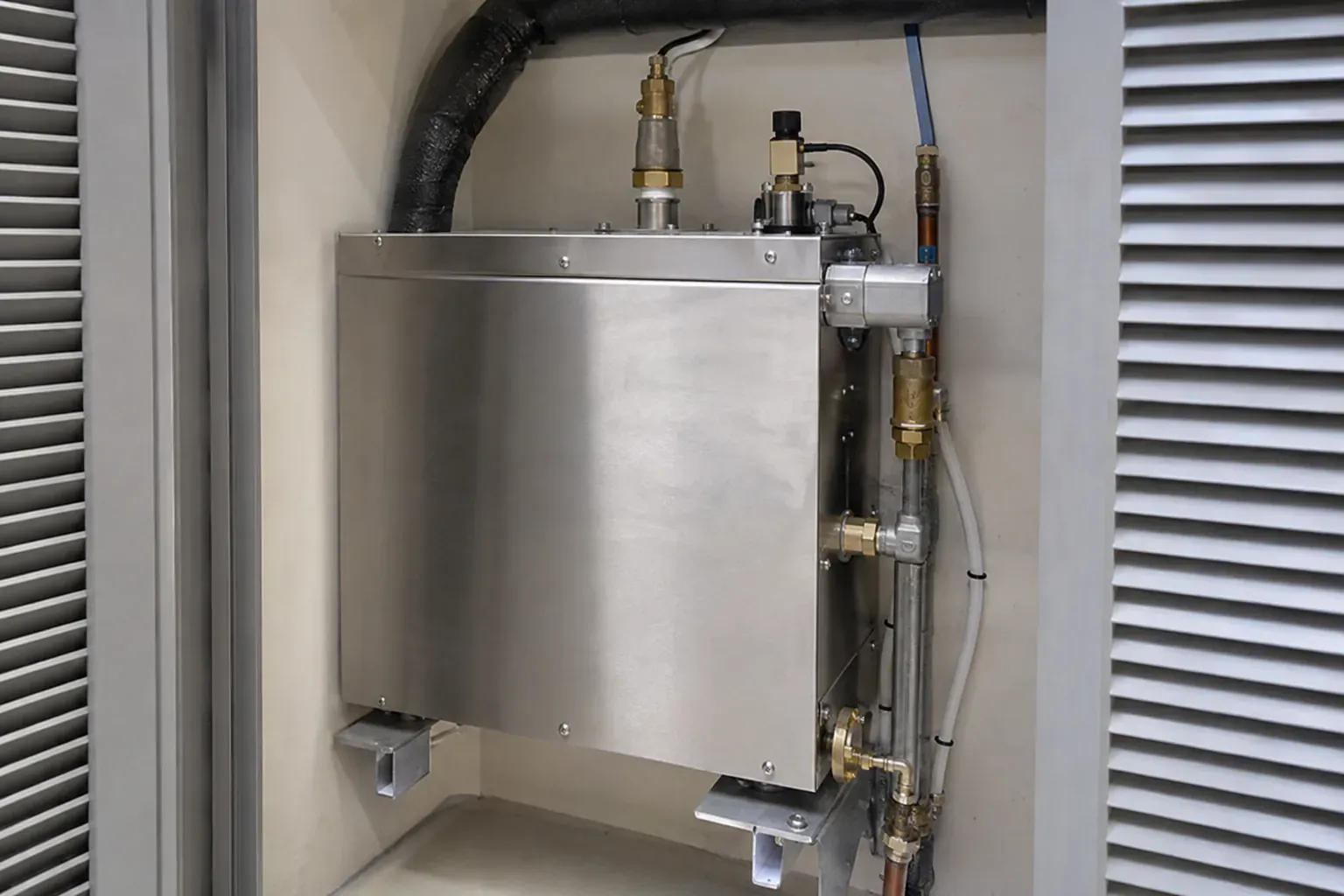
Steam generator sizing: getting the kW right
Undersized steam generators are the most common specification error in this market, and the cause is always the same: somebody sized on floor area.
Steam fills volume. Volume includes ceiling height. And the tile finish changes the answer by as much as the room size does, because stone absorbs an enormous amount of heat before the air ever reaches temperature.
The method
Start with room volume in cubic metres — width by depth by ceiling height.
Multiply by a factor for the finish: roughly 1.0 for standard ceramic tile, 1.3 for large-format porcelain, 1.6 to 2.0 for natural stone such as marble or limestone.
Add capacity for external walls, large glass areas and any uninsulated surface. A room with one wall on an external elevation loses heat continuously in winter and needs a margin.
Round up to the next available unit size. Rounding down is how rooms end up permanently disappointing.
Worked examples
A 1.5 by 2.0 by 2.4 metre room in ceramic: 7.2 cubic metres, factor 1.0, so around 7.2 — a 7.5kW or 9kW unit.
The same room in large-format porcelain: 7.2 by 1.3 gives 9.4 — a 9kW or 12kW unit.
The same room again in marble: 7.2 by 1.8 gives around 13 — a 15kW unit.
Same footprint, same ceiling, three very different generators. This is why a quote that names a generator size without naming the tile has not actually been calculated.
Ceiling height is where people lose
A 1.5 by 2.0 metre room with a 2.2 metre ceiling is 6.6 cubic metres. The same footprint at 3.0 metres is 9.0 — a 36% increase in the load for a room that looks identical on plan.
If your ceiling is high, drop it inside the steam room. You will heat less air, reach temperature faster, and buy a smaller generator that costs less to run for the next decade.
Signs yours is undersized
It takes more than twenty minutes to become usable.
Steam visibly weakens partway through a session as the generator falls behind.
The second session back to back is noticeably worse than the first.
It runs continuously rather than cycling.
All four point at capacity rather than a fault. A correctly sized unit fills the room in ten to fifteen minutes and then cycles.
Oversizing is a real fault too
An oversized generator short-cycles: it surges to temperature, cuts out, cools, and surges again. That is unpleasant in the room and hard on the element and the contactor.
It also wastes water and power on every flush cycle. Bigger is not safer here — correct is.
What the generator needs around it
A dedicated circuit sized to the unit. A 9 to 12kW generator is a substantial load and often lands in the same three phase conversation as a large sauna heater.
A water feed, ideally softened. In UAE mains water this roughly doubles element life.
A drain for the automatic flush cycle. Without an auto-flush that actually works, the tank stands full of hot mineral-laden water between sessions and scales far faster.
Genuine physical access for descaling every six months. Do not let anyone build it into a sealed void.
Getting the number checked
Send room dimensions and the tile finish and we will calculate it in writing. Steam generator supply and sizing covers what we hold and what the lead times are, and steam room installation covers the room the generator has to fill.
As a steam room supplier we do the sizing calculation whether or not you buy the installation from us. We do sauna and steam room installation in Dubai and supply to contractors across the UAE.