
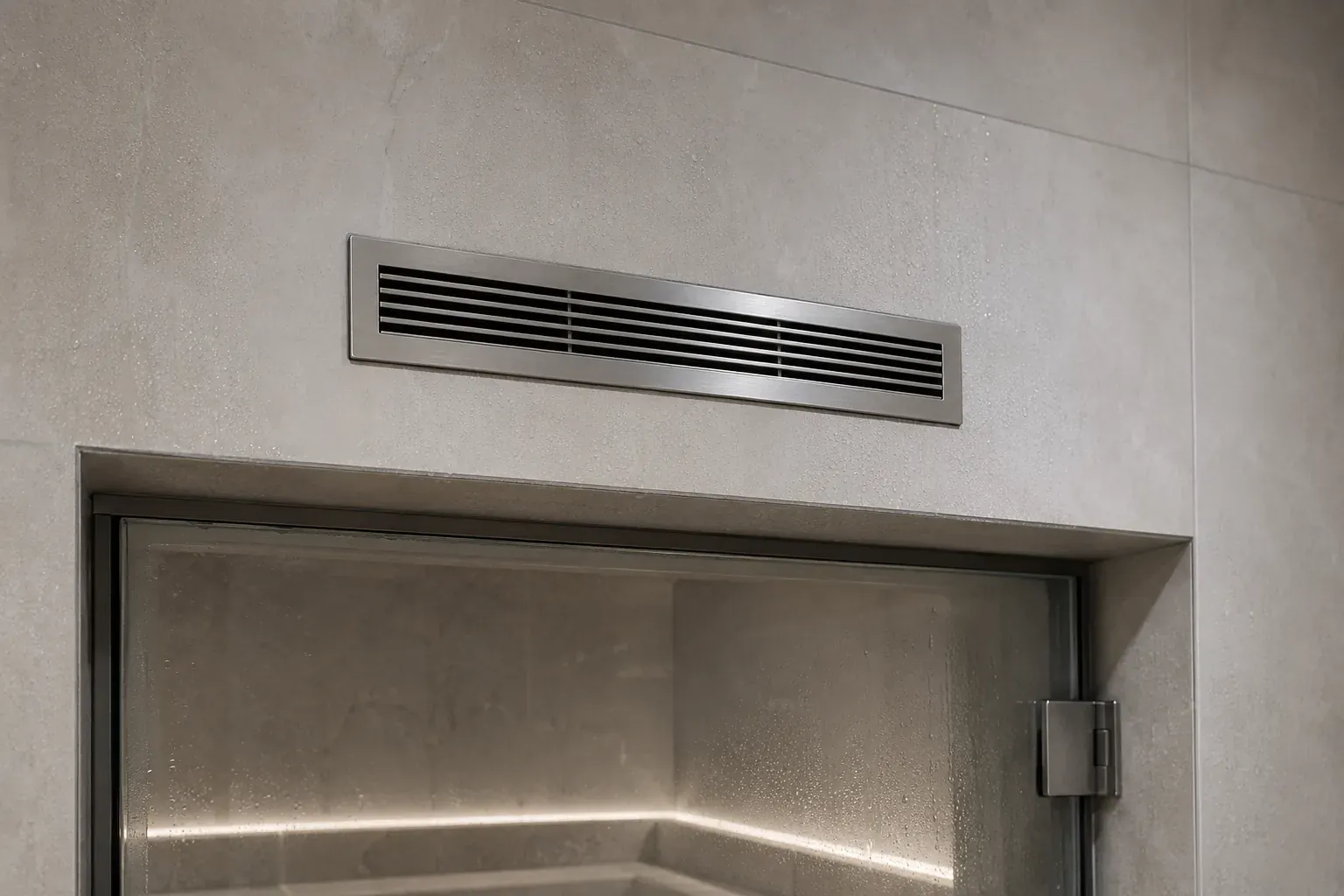
Steam room ventilation, and why yours smells
A steam room that smells is not dirty. It is a room that never dries out, and the cause is nearly always ventilation rather than cleaning.
This is the detail most often skipped in domestic installations, because the room works perfectly well without it for the first few months.
What extract is actually for
Not for use during the session — you want saturation while the room is running. Extract exists to clear the room afterwards.
A steam room holds a great deal of water on its surfaces at the end of a session. If that water evaporates slowly into a sealed room over many hours, everything stays damp continuously and biological growth follows. If it is extracted within thirty to sixty minutes, the room dries and stays clean.
The correct arrangement is an extract fan with a run-on timer, sized to clear the room reasonably quickly, ducted properly to outside rather than into a ceiling void.
Ducting into a ceiling void is a real problem
We find this regularly. An extract fan is fitted, it appears to work, and the duct terminates in the ceiling void above the bathroom rather than at an external termination.
All that does is move the moisture from a tiled room designed for it into a plasterboard void that is not. The steam room stays fresher and the ceiling above eventually stains, sags or grows mould. It is a slow, expensive failure.
Drainage traps that dry out
The second common cause of smell. A steam room point drain or gutter has a trap, and if the room is used infrequently the trap water evaporates and drain gases enter the room.
The fix is a trap designed not to dry out, or simply running water into the drain periodically. If your room smells specifically of drains rather than mustiness, this is almost certainly it, and it is a five minute problem rather than a construction one.
Where humidity goes if it does not go out
Into the bathroom, then into the ceiling void, then into the room above. In a villa that means a stained ceiling. In an apartment it means someone else's stained ceiling, and a conversation with building management.
This is also why apartment buildings scrutinise steam room applications more heavily than villa communities do — the consequences do not stay inside your unit.
Fixing a room that already smells
Check whether an extract exists and whether it actually terminates outside. Run it and hold tissue to the grille.
Check the drain trap. Pour water in and see whether the smell changes within a day.
Check whether the door is left open after sessions. Leaving it ajar is a crude but genuinely effective substitute where retrofitting extract is difficult.
Clean with products appropriate to the grout and any natural stone. Aggressive acidic cleaners will damage stone and attack grout, which creates the porosity that makes the next problem worse.
If none of that resolves it, the smell may be coming from behind the tile rather than in front of it, which is a tanking question rather than a ventilation one.
Saunas have the mirror problem
Worth mentioning because people confuse the two. A sauna does not need extract; it needs air changes during use — a low inlet beside the heater and a high outlet on the opposite wall, three to six changes an hour.
Without it the cabin stratifies badly. The upper bench cooks, the lower bench stays lukewarm, and people conclude the heater is underpowered when the actual problem is that air is not moving. If your sauna has more than about 10°C difference between upper and lower bench, look at the vents before you look at the heater.
Fixing a room that never dries
Steam room maintenance covers extract checks and drain trap work as part of a service visit, and steam room installation covers how ventilation is specified at build stage so it does not become a retrofit.
Sauna servicing addresses the mirror problem in dry cabins, where poor air movement shows up as a cold lower bench. We do sauna and steam room installation in Dubai.