
Six sauna problems we get called out for most
After a few years of service work the same faults come back repeatedly, and most of them trace to something that was decided at build stage rather than something that broke.
Here they are in order of how often we attend them, with what actually causes each and what the fix costs.
1. It does not get hot enough
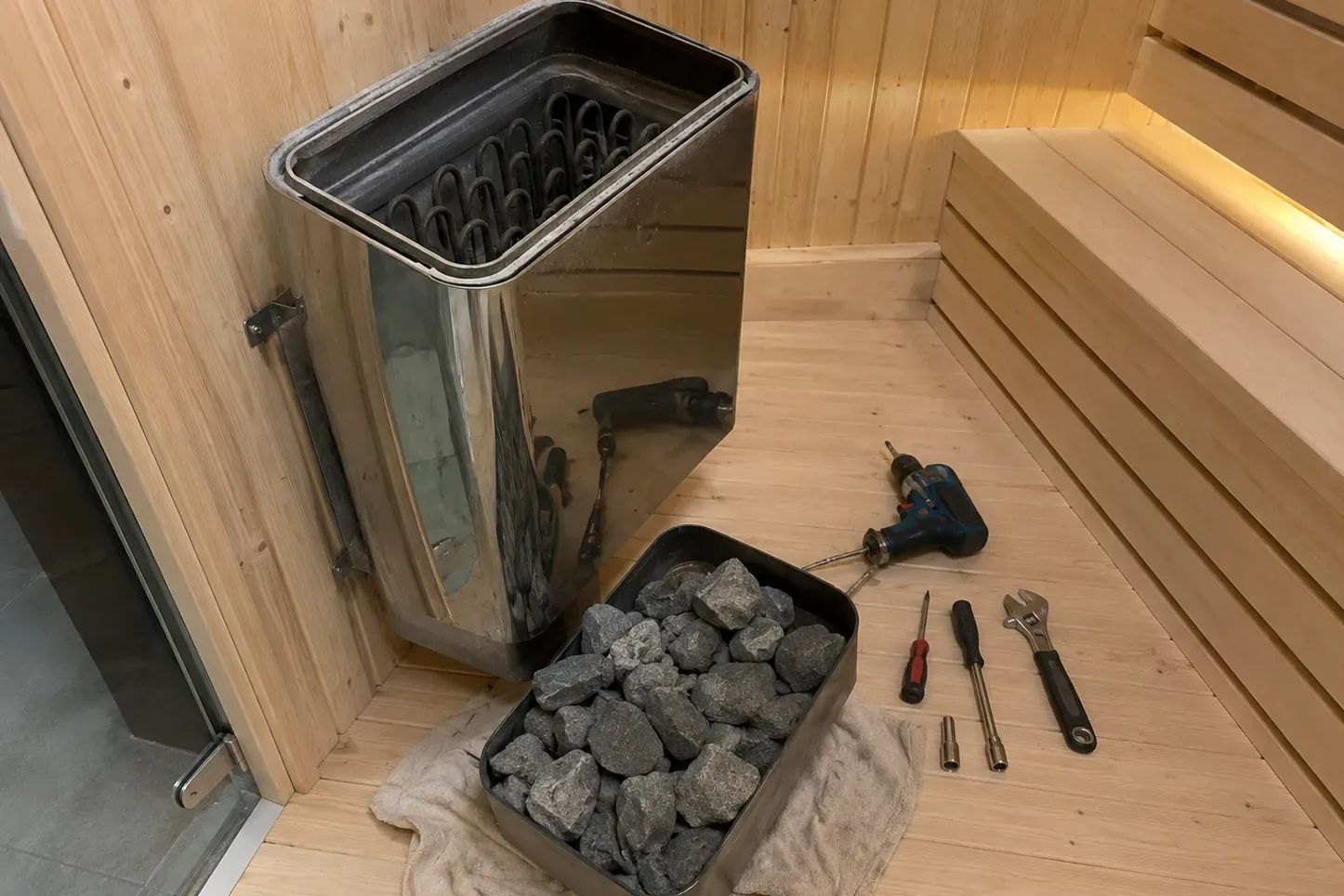
By far the most common call, and the first thing we check is the stones. Fractured stones pack down over time and restrict airflow through the element, so the heater works harder and delivers less. Replacing them is cheap and frequently solves the complaint entirely.
If the stones are fine, the next candidates are a failed element in a multi-element heater — the unit still works, just at reduced output — and a control or limiter fault.
Last, and most annoying to diagnose: the heater was undersized for the room from the beginning. If ceiling height was ignored at specification, no amount of servicing will fix it.
2. The lower bench is cold
Stratification, and it is a ventilation problem rather than a heater problem. Without a low inlet near the heater and a high outlet on the opposite wall, hot air sits at the top and never circulates.
A difference of more than about 10°C between upper and lower bench points at vents. It is correctable after the fact, but it means opening cladding, so it is far cheaper to get right at build.
3. Benches have gone dark, sticky or split
Two separate faults present together. The first is body oils absorbed into the timber. Caught early, sanding back to clean timber restores the boards completely and costs a fraction of replacement. Left for several years, the oil penetrates too deep and they have to be replaced.
The second is splitting along the grain, and it is specific to this climate. Sauna timber is milled in Northern Europe and arrives at a moisture content suited to a cool damp country. It then sits in a Dubai villa held at 22°C and moderate humidity, and gets cycled to 90°C at almost zero humidity several times a week. That swing is far wider than the timber was seasoned for, so it shrinks, and boards fixed too rigidly split rather than move. Summer is when it shows, because the delta between cabin and ambient is at its worst.
The fix is prevention at build stage: timber acclimatised on site for a week or two before installation, bench slats fixed from underneath through slotted holes rather than pinned hard at both ends, and an 8mm gap between slats so each board can move independently. Where boards have already split, individual slats can be swapped — it is one of the cheaper repairs in this list, provided nobody has varnished over the crack first.
The thing never to do is varnish or seal them. Coatings blister at 90°C and trap moisture in the timber underneath, which is worse than the problem they were meant to fix, and they hide splitting until a board fails under load.
4. The heater has failed entirely
Elements and contactors are the usual culprits. Element life is eight to twelve years with correct sizing and stone care, and four to six without.
Replacement is AED 1,800 to 5,500 including parts on most domestic units. We hold parts for Harvia, Tylö, Sawo, EOS and Helo, and lead time is the main variable between brands rather than price.
If the heater is more than twelve years old and the element has gone, replacing the whole unit is often better value than the element alone.
5. The door has dropped or will not seal
Glass sauna doors are heavy, and hinges take a beating from thermal cycling and daily use. A dropped door catches on the frame, stops sealing, and lets heat out continuously — which then presents as complaint number one.
Hinge adjustment or replacement is quick and inexpensive. Worth doing as soon as the door starts catching rather than after the frame has been damaged.
6. There is a smell, or the timber has moved
This is the serious one. A musty smell, cladding that has cupped or pulled at the fixings, or a soft spot behind a panel all suggest moisture has reached the insulation — which means the vapour barrier has been breached.
It is usually a build defect: stapled through the face, joints not taped, or a penetration for a light or sensor never sealed. It is invisible for two or three years and then presents all at once.
We open a section and give an honest assessment. Sometimes it is one panel and a re-detail. Sometimes the cabin needs stripping back to the frame. We would rather tell you which than clad over it, and we have declined jobs where the client wanted the latter.
What prevents most of this
An annual service catches five of the six above as parts due rather than as failures. It costs AED 850 to 1,600, which is less than a single element replacement.
Stone replacement every one to two years is the highest-value single item, because packed stones are what shorten element life more than anything else.
The sixth — vapour barrier failure — cannot be serviced away. It is decided at build, which is why we are inflexible about the detail.
Getting yours serviced
Sauna maintenance and repair covers what an annual service includes, what it costs and what an AMC looks like for gyms and hotels. Sauna heater replacement covers the brands we hold parts for.
If the fault turns out to be a build defect rather than wear, sauna room installation is where we would start again properly. We handle sauna and steam room installation in Dubai and service cabins built by other companies.